Detroit-style pizza at home: the frico edge, the right pan, and brick cheese substitutes
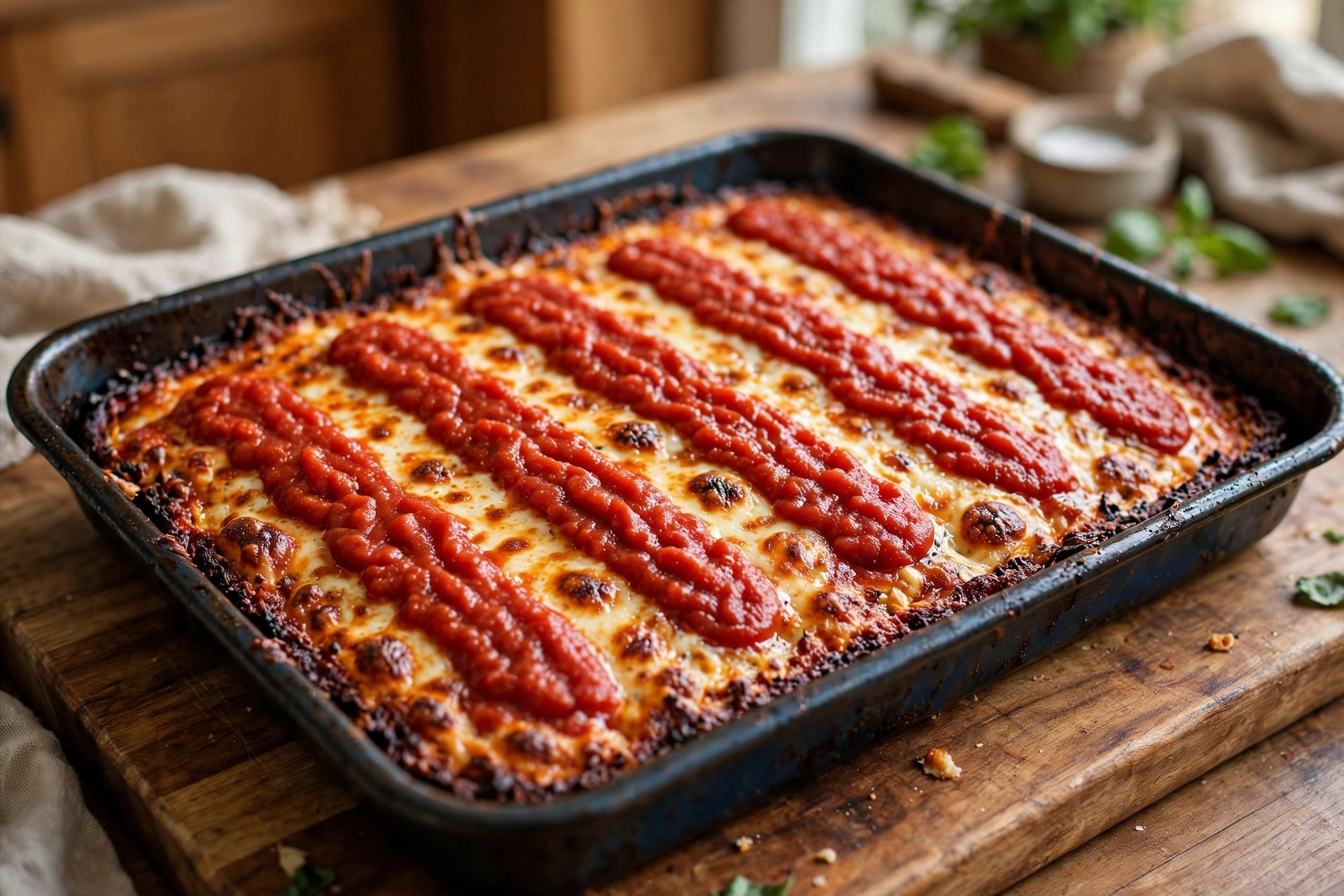
Detroit-style pizza is not simply thick pizza cut into squares. It is a pan system with three moving parts that all have to work at once: a high, straight-sided pan that fries the crust's edges and bottom, a soft pan dough that proofs in that pan until it is airy at the centre and crisp at the base, and cheese deliberately pushed against the pan wall so it melts, fries, and turns into the dark, lacy border — the frico edge — that defines the style. Sauce goes on top, in stripes or dollops, after the cheese. Get the order or the pan wrong and the result can still be good pan pizza, but it will not be Detroit-style.
This guide works through the system in that order: what makes the style itself, the pan with its dimensions verified from a manufacturer spec listing, a dough formula by weight from a flour producer's test kitchen, a framework for substituting the traditional brick cheese, and a numbered bake with the checks that tell you the edge, the crumb, and the bottom all came out right.
What makes it Detroit-style: pan, edge, and sauce on top
King Arthur Baking's survey of artisan styles describes Detroit-style pizza as a very thick crust with an extraordinarily crisp underside, baked in high-sided black steel pans that were originally intended for use in the automotive industry. The same description gives the two topping signatures: cheese from edge to edge, producing a crisp, crown-like rim, and sauce applied on top in stripes, leaving some of the cheese exposed. Those three facts explain almost every step that follows. The pan is high-sided because the dough rises in it and the cheese needs a wall to fry against. The cheese reaches the wall because the rim is the point of the style, not a garnish. The sauce sits on top because a wet layer between dough and cheese would steam the crumb and because stripes leave much of the cheese free to brown.
The order matters more than most recipes admit. In one widely used published recipe, cheese is sprinkled all the way to the edges first, sauce is dolloped over it, and pepperoni goes on last — and the recipe carries a note correcting its own video, which had shown a different order. That small editorial embarrassment is instructive: if the order did not matter, nobody would need to correct it. Cheese first, against the wall, is what fries. Sauce first would put a moisture barrier exactly where the cheese needs direct contact with hot metal and hot dough.
The pan, verified: dimensions, material, and substitutes compared
The reference home pan is the LloydPans Detroit-style pan in its nominal 10 by 14 inch size. The manufacturer's spec listing, checked for this guide, gives the working dimensions precisely: 2.5 inches deep, with an inside top measurement of 9 5/8 by 13 5/8 inches, made from 14-gauge hard-coat anodized aluminium. Its Pre-Seasoned Tuff-Kote finish is described as a permanent, stick-resistant coating that needs no pre-seasoning, the rim is double-thick and flat for strength, and the sides sit at a 76-degree angle so empty pans nest. Two practical consequences follow. First, the depth is not decorative: a pan much shallower than 2.5 inches gives the rising dough and the cheese rim nowhere to go. Second, the spec listing warns that dark-coated pans can bake a darker crust, so temperature or time may need adjusting down slightly compared with a light pan — a useful warning when the goal is a dark edge that is caramelised, not scorched.
King Arthur sells its own Detroit-style pan in black anodized aluminium, described as browning the crust without burning with an easy-release interior; its listed price was $69.95 USD when checked on October 16, 2026. A dedicated pan is the reliable route, but it is not the only one. The comparison below is this guide's synthesis of the pans named across the source recipes, with the trade-off of each stated plainly.
| Pan | What you get | Watch out for |
|---|---|---|
| Detroit-style pan, 10 x 14 x 2.5 in | Correct depth and side angle; cheese rim forms against a straight wall; stick-resistant finish needs no seasoning | Dark coatings brown faster; a single-purpose pan to store |
| 9 x 13 in cake pan | Named as an alternative in King Arthur's recipe, which also allows a 13 x 18 in half-sheet tray; most kitchens already own one | Shallower and often sloped-sided; scale dough and cheese down a little and expect a softer rim |
| Cast iron skillet | Heavy base heat and a crisp bottom; round Detroit-style riffs are published for it | Round, not rectangular: no corners, and the corner pieces are part of the style's appeal; cheese rim forms only around a curve |
| Half-sheet tray | Works for a larger, thinner batch using the same dough | Very shallow sides; the frico rim is minimal and the crumb bakes thinner, closer to a grandma style |
Whichever pan is used, it gets oiled, including up the sides. King Arthur's method divides the dough's olive oil so that part goes into the dough and the rest coats the inside of the pan, sides included — the oil is part of the frying system for the bottom and rim, not just insurance against sticking.
The dough: a high-hydration pan dough, by weight
King Arthur's Detroit-style dough is a useful anchor because every quantity is given in grams: 360g bread flour, 270g lukewarm water, 8g table salt, 3g instant yeast, and olive oil divided between dough and pan. The arithmetic is worth doing once: 270 divided by 360 is 0.75, so this is a 75% hydration dough — noticeably wetter than a typical round-pizza dough, which is why it is handled with folds rather than kneading and why it spreads and proofs in the pan instead of being stretched in the air. That wetness is the crumb: a slack, well-hydrated dough proofs into the light, open interior that contrasts with the fried exterior.
The handling in the same recipe is minimal and timed. The ingredients are mixed until thoroughly combined, then the covered dough rests 15 minutes and receives a bowl fold — a wet hand lifting a section of dough and pressing it into the middle, repeated around the bowl — then rests another 15 minutes and is folded again. After the second fold it rests about 1 to 1.5 hours, until slightly puffy but not necessarily doubled. The dough is then pressed into the oiled pan with fingertips, dimpling the surface and encouraging it to cover the base; if it resists, the recipe's fix is patience, not force — cover it, rest 30 minutes, and stretch again. A final rest of 45 to 60 minutes in the pan, until slightly puffed, completes the proof. A second published recipe, at a smaller scale, follows the same shape with different numbers — about 2 hours for the first rise until doubled, then at least 30 minutes of resting in the pan — which confirms the structure while showing that the clock times flex with dough and kitchen.
Brick cheese and what to use instead
The traditional cheese is Wisconsin brick cheese, and King Arthur's own Detroit recipe notes the style layers toppings in reverse order — cheese first, brick cheese to be totally traditional, then sauce. Brick cheese can be hard to find outside the American Midwest, so the real question is what a substitute must do. It must melt fully at pan-bake temperatures, it must fry at the wall into a crisp, savoury rim rather than pooling into grease, and it must be mild enough to let the sauce stay bright. Several published recipes cut the cheese into half-inch dice rather than shredding it; diced cheese distributes in distinct pockets, melts a little more slowly at the wall, and is the form to copy with any substitute.
The decision framework is simple. If brick cheese is available, use it, diced, taken to the edges. If it is not, the best-documented substitute in the source recipes is a mixture: one published recipe uses 170g of Monterey Jack and 170g of mozzarella, each cut into half-inch dice — the Jack supplying brick's easy melt and mild tang, the mozzarella supplying stretch. Low-moisture mozzarella alone is the third option: it fries reliably at the wall and is available everywhere, but the flavour is milder and the rim a little less rich. What to avoid is fresh mozzarella as the edge cheese: its job in other styles is gentle melting, and at the pan wall its moisture works against the crisp rim this style is built around. In every case, quantity follows placement, not habit: cheese the centre last, after the corners and walls are covered, because a rim with gaps fries in patches.
Detroit-style pizza, step by step
One: mix 360g bread flour, 8g salt, and 3g instant yeast; add 270g lukewarm water and a generous tablespoon of olive oil; mix until fully combined. Two: rest 15 minutes, bowl fold, rest 15 minutes, bowl fold again; then rest 1 to 1.5 hours until slightly puffy. Three: coat the pan, sides included, with the remaining olive oil; press and dimple the dough to cover the base, resting it 30 minutes if it springs back; proof in the pan 45 to 60 minutes. Four: while the dough proofs, preheat the oven to 500°F with a stone or steel on the bottom rack, following King Arthur's setup. Five: dice the cheese and place it deliberately — corners first, then against all four walls, then the centre. Six: dollop or stripe the sauce over the cheese, leaving cheese exposed, and add pepperoni or other toppings last. Seven: bake until the rim is deeply caramelised and dark at the edges; the published recipes bracket this at about 15 minutes at 500°F for a topped pizza, and King Arthur's frico variation — an 8-minute untopped parbake at 475°F, then cheese and sauce, then 10 to 12 minutes more — for bakers who want the edge maximally crisp. Eight: as soon as the pizza leaves the oven, run a knife or spatula between the pizza's edge and the pan side so the cheese does not glue itself in place as it cools, rest briefly, then lift the whole pizza out before slicing into squares.
What success looks like: corners and edges carry a continuous dark, lacy rim that crackles when cut; the bottom is evenly crisp, not pale; the centre crumb is open and airy rather than dense; and the pizza releases from the pan in one piece, leaving the pan nearly clean. A pale rim means the cheese never truly met the wall or the bake was short; a dense centre means the in-pan proof was rushed; a stuck rim means step eight was skipped.
FAQ
Can Detroit-style pizza be made without a Detroit pan? Yes — a 9 x 13 inch cake pan is the substitute named in the source recipes. Expect a slightly shallower pizza and a softer rim, scale the dough and cheese down a little, and keep the cheese-to-the-wall placement, which matters more than the pan's brand.
Why is the sauce on top? Cheese first protects its contact with the pan wall, which is what fries into the frico edge, and stripes or dollops of sauce leave much of the cheese exposed to brown. Sauce under the cheese would steam the crumb and interrupt the rim.
What if brick cheese is unavailable? Use the documented substitute pattern: equal parts Monterey Jack and mozzarella, diced rather than shredded, with low-moisture mozzarella alone as the widely available fallback. Keep the placement — corners and walls first — unchanged.
General cooking information only. Pans and cheese rims leave the oven extremely hot; use mitts and let the pan cool before handling or washing.