Freezing pizza dough balls: when to freeze, how long they keep, and how to thaw
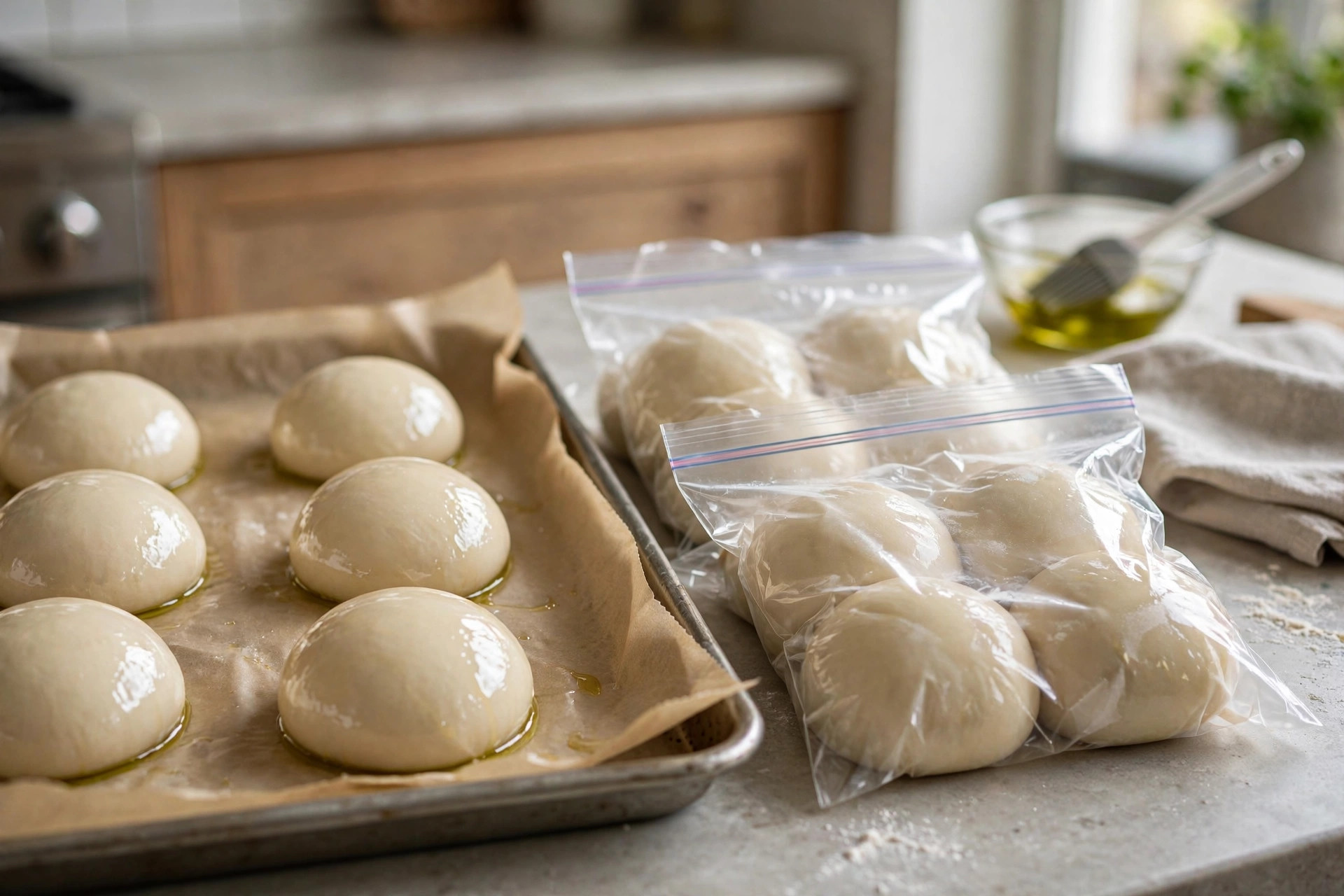
Freezing pizza dough should be the simplest trick in home pizza: make a double batch on a quiet day, and future pizza nights start from the freezer instead of the flour bin. Instead, anyone who reads three guides before starting meets three different answers to every question that matters. Freeze before the rise, after the rise, or after a day in the fridge? Keep the balls two weeks, forty-five days, or three months? Thaw on the counter for half an hour, or for most of an afternoon? The guides are not all wrong — they are answering for different doughs and different schedules, and they rarely say so.
This guide reconciles them instead of picking a winner. The freeze points are compared side by side with the method each belongs to, the storage limits are kept attached to the sources that published them, and the thaw is written as one procedure with explicit readiness checks, so the dough itself — not a clock borrowed from the wrong recipe — decides when it is ready to stretch.
Why freezing works: yeast in suspended animation
America's Test Kitchen, describing its tested method for refrigerated thin-crust dough, puts the mechanism plainly: freezing puts the yeast into suspended animation. Fermentation stops, which is precisely what a baker wants from storage — the dough cannot overproof in the freezer the way it eventually will in the fridge. The same source explains the subtlety that shapes the whole topic: doughs proofed at room temperature can easily overproof as they thaw, because the yeast wakes up while the baker is not watching the clock, whereas doughs that were refrigerated ferment slowly enough that flexibility remains intact through thawing. In other words, freezing works for every dough, but how forgiving the thaw is depends on how the dough was handled before it froze — which is why the freeze point, the subject of the next section, is a real decision and not a detail.
One temperature anchors the storage side. The US Food and Drug Administration's Food Facts guidance tells home cooks to verify with an appliance thermometer that the freezer holds consistently at 0°F or below, and the refrigerator at 40°F or below. Every storage limit in this article assumes that freezer. A warm or frequently opened freezer shortens real-world keeping quality no matter what any guide promises, and a cheap thermometer removes the guesswork for the price of a cup of coffee.
The freeze point: three methods compared
The comparison below is this guide's synthesis of the three published methods, each kept with its own source and limit. Read it as a menu, not a ranking: the right row is the one that matches the dough in hand and the day it was made.
| Freeze point | Method and source | Published limit | Best for |
|---|---|---|---|
| Right after balling | Baking Steel: ball the dough, freeze, then thaw wrapped in the fridge about 24 hours plus 3 to 4 hours at room temperature | Up to 45 days | Batch day: mix, ball, and freeze in one session with no rise to schedule |
| After the first (full) rise | The Kitchn: let any dough fully rise, divide into single-pizza pieces, coat with oil, bag with air squeezed out | Up to 3 months | The general home pattern; flavour from the rise is already developed before freezing |
| After a 24-hour fridge proof | America's Test Kitchen: refrigerate and proof 24 hours, ball, freeze firm on a tray about 3 hours, then wrap individually | Up to 2 weeks | Cold-fermented thin-crust dough, where the tested window is deliberately conservative |
Two neighbouring formats deserve a sentence each, because search results raise them and they are not the same product. Shaped, rolled-out rounds freeze faster to thaw but take more freezer space, and par-baked bases are faster still — both trade a little crust quality and a lot of space for speed. Balls remain the default for a reason: least space, best quality, and a thaw that doubles as the final proof. Freezing a fully topped raw pizza is a different problem, with topping moisture and food-safety questions of its own, and it is out of scope here.
How long frozen dough balls keep, honestly
The honest answer is that the published limits span 2 weeks to 3 months because they measure different things. America's Test Kitchen's 2 weeks is the tested window for one specific refrigerated thin-crust dough, published with its method. Baking Steel's 45 days is the limit for its own dough and its freeze-after-balling method. The Kitchn's 3 months is a general ceiling for dough frozen after a full rise, well wrapped. None of the three contradicts the others once each limit stays attached to its method — and a baker who freezes an untested dough and quotes the longest number is borrowing confidence the source never offered.
The decision framework that follows from that is practical. Cooking within a fortnight: any of the three methods works; choose by schedule. Stocking a freezer for one to two months: use the after-rise method with the most careful wrapping — oiled balls, air squeezed from the bag — because wrap quality, not the calendar, is what fails first, as surface drying and freezer burn. Planning beyond two months: freeze in smaller, dated batches and rotate, treating anything approaching the 3-month general ceiling as the outer edge rather than a target. In all cases, label each bag with the dough, the freeze point, and the date; an unlabelled frozen ball is a small mystery that wastes exactly the convenience freezing was meant to create.
Freezing dough balls, step by step
The procedure below follows the after-rise method, the most general of the three, with the tray-freeze step borrowed from the Test Kitchen method because it keeps balls separate and unwrinkled. One: make the dough and let it complete its first rise. Two: divide it into single-pizza balls at the weights the recipe intends, and shape each ball smooth and tight. Three: lightly coat each ball with olive oil or baking spray, turning it so the whole surface is filmed — The Kitchn's step, and the dough's protection against drying. Four: set the oiled balls on a parchment-lined tray and freeze until firm, about 3 hours by the Test Kitchen's timing, so they hold their shape in the bag. Five: wrap each firm ball individually, or place each in its own freezer bag, squeezing out all the air before sealing. Six: label with dough, freeze point, and date, and return to a freezer verified at 0°F or below. Seven: keep within the limit that matches the method used — and when in doubt, the shorter published window is the safer promise to make to a future dinner.
What success looks like at this stage: balls that froze as smooth, separate spheres, in bags with no visible frost pockets inside and no dried, pale patches on the dough surface when they are eventually unwrapped. A ball that froze stuck to its neighbours, or in a bag full of loose air, will thaw unevenly and dry at the edges — recoverable, but a sign the wrapping step needs more care next batch.
Thawing and the readiness checks
Every source agrees on the spine of the thaw, and the agreement is worth trusting: the fridge does the thawing. The Kitchn thaws the ball in its bag in the fridge overnight, at least 12 hours. The Test Kitchen unwraps the ball into a lightly oiled bowl, covers it, and refrigerates 12 to 24 hours. Baking Steel keeps the ball wrapped for about 24 hours in the fridge. Plan on 12 to 24 hours and the methods stop looking contradictory. The FDA guidance supports the spine from the safety side: the refrigerator is a listed safe defrosting method, and thawing at room temperature on the counter is explicitly not one — the counter time that follows a fridge thaw is proofing, a baking step performed on already-thawed dough, which is a different thing and should be kept to what the dough needs rather than stretched into an afternoon of neglect.
Where the sources genuinely diverge is that counter proof: about 30 minutes in The Kitchn's method, 3 to 4 hours in Baking Steel's, and 1 to 3 hours in a secondary guide that helpfully lists the readiness signs instead of leaning on the clock. The divergence makes sense once the freeze points are remembered — a ball frozen right after balling still owes most of its proof after thawing, while a ball frozen after a full rise owes very little. So thaw by checks, not by a borrowed number. The ball is ready when it feels puffy and soft, when a gentle poke leaves a shallow dent that slowly springs back, and when a lifted edge stretches without tearing or snapping back. Cold, tight, or tearing means more counter time in a lightly oiled, covered container; slack and soupy means it has gone past, and the pizza should be baked promptly and the next ball given less time. What success looks like: a thawed ball that stretches to size with the same ease as the fresh dough it was made from, proofs visibly, and bakes with normal oven spring — a result every one of the three methods, followed on its own terms, is designed to deliver.
FAQ
Can dough be refrozen after thawing? The sources for this guide do not cover refreezing, and the quality logic argues against it: each freeze and thaw costs the yeast vigour and the surface moisture that the readiness checks depend on. Freeze in single-pizza balls so only what is needed ever gets thawed.
Which freeze point tastes best? The after-rise and after-fridge-proof methods freeze dough whose flavour is already developed; the after-balling method develops its flavour during the long thaw and counter proof instead. Followed properly, all three are published as producing pizza comparable to fresh — the deciding factor is the baker's schedule, not a proven flavour winner.
The thawed dough will not stretch and keeps snapping back. What happened? It is under-proofed after thawing, not ruined. Cover it in a lightly oiled container, give it more counter time, and re-test with the poke and stretch checks: a shallow, slow-springing dent and an edge that stretches without tearing mean it is ready.
General cooking and food-storage information only. Verify freezer and refrigerator temperatures with an appliance thermometer, and when storage history is in doubt, discard the dough rather than baking it.