Neapolitan-style pizza in a home oven: what is actually achievable
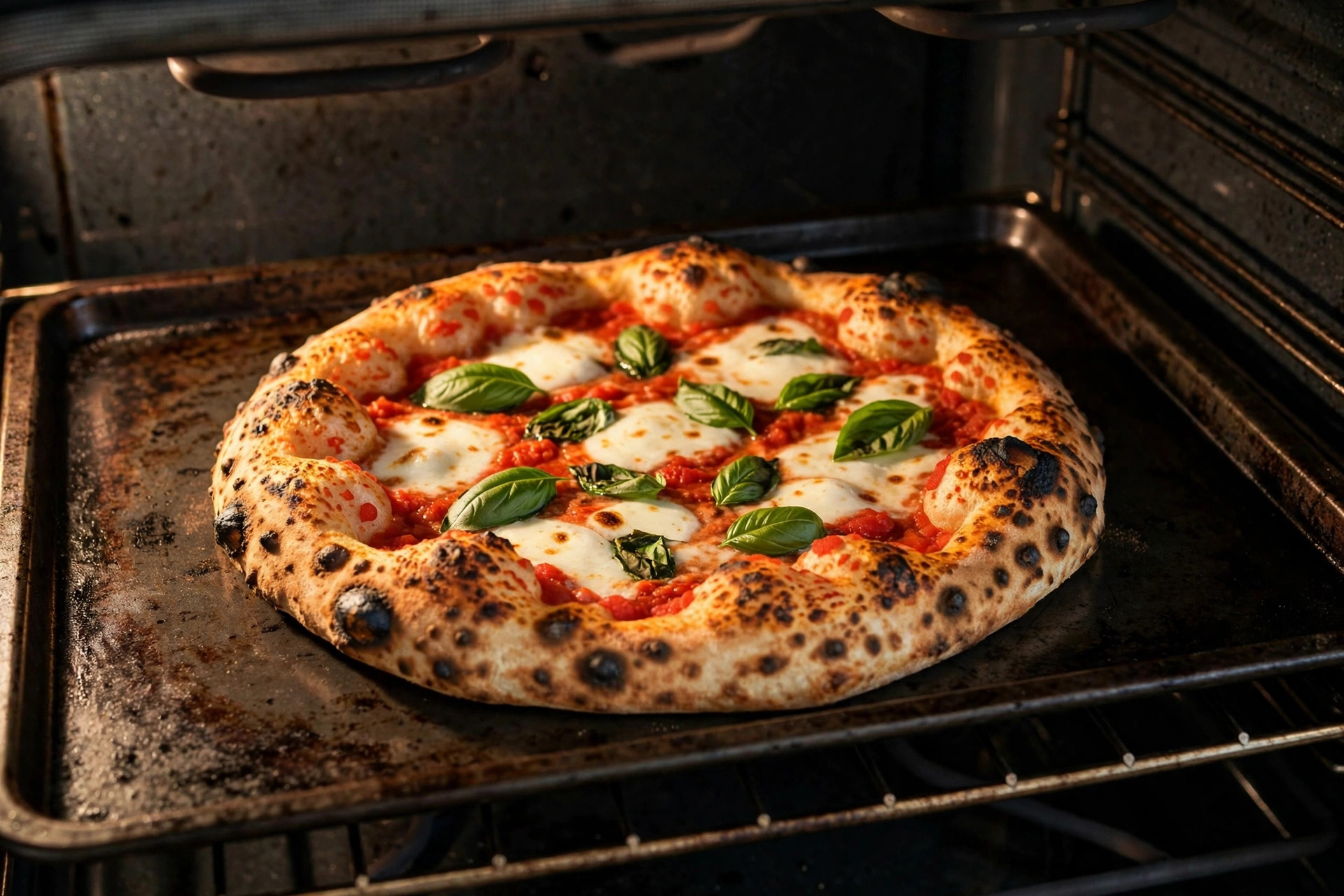
Most “authentic Neapolitan pizza at home” recipes skip the awkward part: the official version of this pizza is defined around an oven no home kitchen has. That does not make the home version pointless — a soft, puffy-rimmed, lightly charred pizza is absolutely achievable in a domestic oven — but it does mean the honest goal is Neapolitan-style, with a short list of things that genuinely carry over and a short list of things that cannot. This guide starts from the official specification itself, sets it against what a home oven can actually do, and then builds the method around the gap instead of pretending the gap is not there.
The official spec, in numbers
The Associazione Verace Pizza Napoletana (AVPN) publishes the production rules for Vera Pizza Napoletana, and the cooking section is blunt. The pizza must be cooked directly on the stone surface of the oven, never in a pan. Cooking must take place in a wood-fired oven that has reached a cooking temperature of 485°C (905°F), with a cooking-surface temperature of roughly 380–430°C and a dome temperature of about 485°C. Cooking time should not exceed 60–90 seconds. The topping quantities are specified just as tightly for a Margherita: 60 to 80g of crushed peeled tomatoes spread from the centre, 80 to 100g of mozzarella cut into strips, and 4 to 5g of extra virgin olive oil applied in a spiral. The finished pizza is characterised by a raised, golden rim, a soft and elastic texture, and a centre that folds easily.
Hold those numbers in mind, because everything about the home method is a negotiation with them. The defining event of the real bake — a full minute and a half at most, on a surface hotter than most home ovens’ maximum air temperature — cannot be reproduced. What can be reproduced is the dough, the shaping, the topping restraint, and a bake engineered to imitate the spec’s effects in the order that matters most.
Reality check: the spec vs a home oven
| Factor | AVPN specification | Home oven reality |
|---|---|---|
| Oven | Wood-fired, exclusively | Electric or gas oven, maximum typically 500–550°F (260–290°C) |
| Baking surface | Stone oven floor at 380–430°C | Baking steel or stone preheated inside the oven |
| Bake time | 60–90 seconds | About 6 minutes on a steel or 7 minutes on a stone, plus 2–3 minutes under the broiler, per King Arthur Baking’s home method |
| Toppings (Margherita) | 60–80g tomato, 80–100g mozzarella, 4–5g olive oil | Fully achievable — the quantities transfer exactly |
| Finished texture | Soft, elastic, foldable, raised golden rim | Achievable in character; the rim puffs and spots, but the centre stays softer-set than crisp |
The table is this guide’s own comparison, built from the AVPN specification and King Arthur Baking’s published home-oven method, both checked on October 18, 2026. The one row where home bakers usually go wrong is bake time: stretching a 90-second pizza into a 9-minute bake dries the rim and toughens the crumb, so the method below keeps the total bake as short as the oven allows and uses the broiler as a finishing heat source rather than baking under it from the start.
What carries over, and what does not
The decision framework is simple. Chase, in this order: the dough formula and its long, slow rise; the shaping that protects the rim; the specified topping weights; and the hottest, shortest bake the oven can manage. Drop, without regret: any claim of authenticity (the spec reserves the name for the wood-fired bake), any attempt to match the 60–90 second timing, and any topping load beyond the specified weights — extra cheese and sauce are the fastest way to turn a soft-centred style into a soggy one, because the home bake gives moisture far longer to soak in than the Neapolitan bake does.
One equipment choice does real work here. King Arthur’s method preheats a baking steel or stone in the oven and finishes under the broiler; the Baking Steel company, which sells steels, argues that steel transfers heat to the dough far faster than stone and shortens the bake accordingly. Treat that as a vendor’s claim with a plausible mechanism rather than a neutral measurement — but note that King Arthur’s own timings point the same direction, at about 6 minutes on steel against 7 minutes on stone before the broiler finish. Either surface works; the steel buys a slightly faster, better-browned bottom.
The dough: a lean ‘00’ formula by weight
King Arthur Baking’s Neapolitan-style crust is the anchor formula here because every quantity is weighed: 232g ‘00’ pizza flour, 170g lukewarm water, 8g table salt, 1/8 teaspoon instant yeast, and 1/2 teaspoon sugar, yielding two 10- to 12-inch pizzas. The arithmetic is worth doing once: 170 divided by 232 is about 0.73, so this is roughly a 73% hydration dough, and the tiny yeast quantity is the point — the dough rises at room temperature for at least 12 hours and up to 24, becoming a bit puffy rather than doubling. King Arthur describes its ‘00’ flour as milled to precise ‘00’ standards with a silky texture that shapes easily and yields a chewy crust; the long, cool rise is what builds the flavour that the fast, hot bake then has no time to add.
After the rise, the dough is divided into pieces of about 200g, each stretch-and-folded on all four sides, pulled into a smooth ball with the seams tucked underneath, and rested seam-side down in a floured bowl for 45 minutes to an hour while the oven preheats. That second rest is not optional padding: a cold or tense dough ball springs back during shaping and tears at the centre, and the rim — the part of this style that matters most — never gets its chance to puff.
Neapolitan-style at home, step by step
One: mix 232g ‘00’ flour, 8g salt, 1/2 teaspoon sugar, and 1/8 teaspoon instant yeast; add 170g lukewarm water (105–115°F) and stir to a rough, cohesive dough. Two: cover and rise at room temperature for 12 to 24 hours, until puffy. Three: place a rack in the centre of the oven with a baking steel or stone on it, keeping at least 8 inches of clearance below the broiler, and preheat to 500–550°F — the oven must sit at full temperature for at least 30 minutes so the surface heats through. Four: divide, fold, and ball the dough as above; rest the balls 45 to 60 minutes. Five: on a well-floured surface, press the dough out with fingertips, never touching the outer edge — the untouched circumference is what becomes the bubbly rim. Six: lift the round onto knuckles and stretch to 10–12 inches, letting gravity do the work and resting the dough 5 to 10 minutes if it resists. Seven: move to a generously floured wooden peel (or parchment on a metal peel, trimmed flush with the dough), top lightly — for a Margherita, 60–80g crushed tomato and 80–100g mozzarella in strips, per the specification — and confirm the pizza jiggles freely on the peel. Eight: launch onto the steel or stone and bake about 6 minutes on steel or 7 minutes on stone. Nine: switch to the top broiler for 2 to 3 minutes, watching constantly and rotating as needed, until the rim is bubbly and charred in spots; skip the broiler entirely if it is a bottom drawer broiler, and simply bake a few minutes longer instead. Ten: rest the surface between pizzas — switch back to bake mode and let the steel or stone reheat while the second pizza is shaped and topped.
What success looks like: a raised rim that is golden with dark blistered spots and stays soft when squeezed, a centre that is set but supple enough to fold without cracking, cheese melted in patches rather than pooled, and a bottom that is mottled gold rather than pale or uniformly crisp. A rim that comes out hard and crackery means the bake ran long; a centre that slumps wet means the toppings exceeded the specified weights or the surface had not preheated for the full 30 minutes at temperature.
FAQ
Can a home oven make authentic Neapolitan pizza? No — and that is the specification’s position, not a judgement on quality. The AVPN rules require a wood-fired oven at about 485°C and a bake of 60–90 seconds, neither of which a domestic oven can reach. The home version is Neapolitan-style: same dough logic, same shaping, same topping weights, longer and cooler bake.
Is ‘00’ flour required? It is what the anchor formula is built on, and its fine milling is part of how the dough stretches thin without tearing. The formula’s structure — roughly 73% hydration, very little yeast, a 12- to 24-hour rise — matters more than any single ingredient; keep those intact if flour is substituted and expect a slightly different chew.
Why finish under the broiler instead of baking longer? Because the rim needs radiant heat from above to blister before the bottom overcooks, and King Arthur’s method reserves the broiler for the final 2 to 3 minutes for exactly that reason. The 8-inch clearance rule is a safety line from the same recipe: closer than that, the top burns before the bottom bakes through, and parchment edges can scorch.
General cooking information only. Home ovens and broilers vary; keep at least 8 inches between the pizza and a top broiler, watch the broiler finish continuously, and trim parchment flush with the dough at these temperatures.