New York-style pizza at home: big foldable slices from a home oven
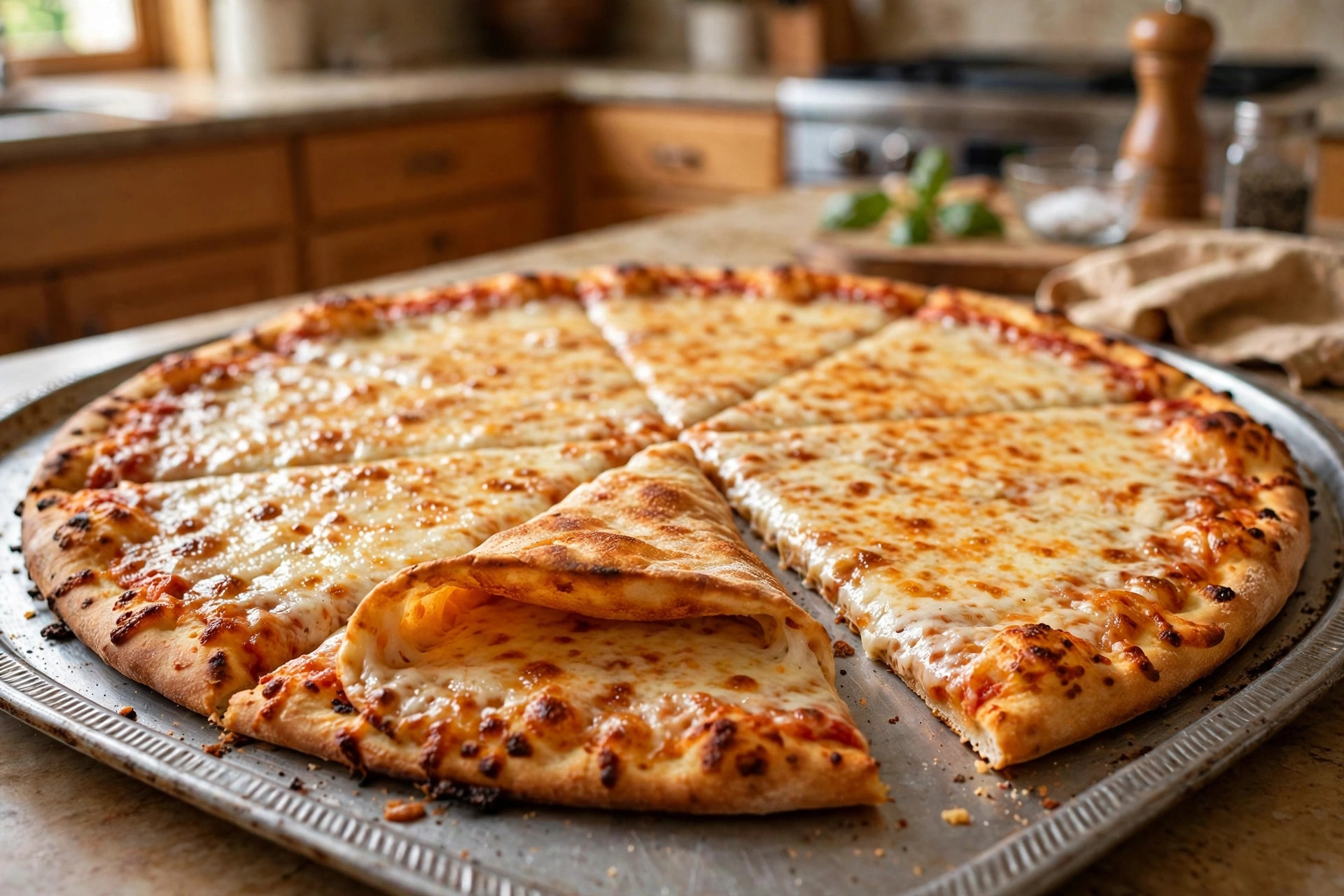
A New York slice is defined by a physical test, not by a topping list. Pick it up, fold it lengthwise, and it should bend without breaking, hold its tip up without drooping into your wrist, and eat crisp on the outside and chewy inside. Most home recipes quietly abandon that test: they make a perfectly pleasant 12-inch pizza, cut it into small triangles, and call the job done. The home baker who actually wants the slice has to solve three different problems — scale, because the style's slices come from large pies; structure, because a big thin slice flops for identifiable reasons; and heat, because the pizzeria deck oven behind the style is not the oven in a home kitchen.
This guide takes the three in order. A dough-weight table scales the pie up from a verified flour-producer anchor. The sauce and cheese follow the style's documented pattern — seasoned sauce, grated low-moisture mozzarella. And a numbered bake on a preheated steel ends with a flop diagnosis: four causes, each with its fix, so a drooping tip becomes information instead of disappointment.
What a New York slice has to do: the fold test
When PMQ, the pizza industry magazine, asked six chefs to define the style, their musts converged on structure: a thinner, well-stretched pie with a defined crust edge, a bake on the well-done side, reasonable amounts of sauce, cheese, and toppings so slices keep their integrity, and a slice big enough to fold but with enough integrity not to flop or fall apart. The texture standard from the same chefs is precise — thin but not cracker-thin, pliable enough to fold in half lengthwise without breaking, a crisp outer layer over a chewy interior, and an edge that stays puffy and chewy. Size is part of the definition, too: the same source notes these pies can reach 20 inches across, with a golden-brown bottom carrying only limited char.
King Arthur Baking's dough roundup makes the same promise from the recipe side: its New York-style dough, originally from its Book of Pizza, yields a thin, crispy yet foldable crust with what it calls a no-dip tip, and credits a hot oven and a baking steel with producing the fully browned bottom that emulates the twice-baked slices sold by the slice. Foldable, no-dip, well-browned underneath — that trio is the success standard for everything below, and it is testable on the first slice, which is exactly how it should be used.
The dough: weight by diameter, and why oil and sugar are in it
The verified anchor is King Arthur's New York-style recipe: the dough — flour, sugar, salt, and yeast combined, then oil and water — is rested 1 hour, divided into two pieces of about 300g each, and balled tightly, seam-side down, into a lightly greased container. From that single anchor, the table below scales dough weight by diameter using pizza area, so the thickness that works at one size carries to the others. It is this guide's computed guidance, anchored on the 300g ball, not a figure quoted from any single recipe — use it to keep thickness constant while the pie grows.
| Pie diameter | Dough ball | Best use at home |
|---|---|---|
| 12 in | About 210g | Small oven or steel; slices fold, but read as personal-pizza size |
| 14 in | About 285g | Closest to the 300g anchor ball; the easiest true slice size on a standard steel |
| 16 in | About 375g | The classic counter slice; needs a steel or stone that actually fits it |
| 18 in | About 475g | Full pizzeria scale; check oven and peel width before committing |
Two ingredients in the dough surprise bakers coming from Neapolitan recipes: oil and sugar, both present in the King Arthur formula and in most of the home recipes in the search results. Their presence is an adaptation, and the logic follows from the bake. A New York pie bakes far longer than a Neapolitan pizza, at lower relative heat, and a lean flour-water-salt-yeast dough can dry and pale over that longer bake; oil keeps the crumb tender through it, and sugar supports browning on a crust that will never see wood-fire temperatures. Treat them as structural, not as sweetening or greasing for its own sake — and note what the chefs add on the time side: long fermentation develops the flavour that shortcuts and frozen dough do not, which is why the King Arthur schedule rests the balled dough 8 to 10 hours at room temperature, or refrigerates it for up to 3 days, before baking.
Shaping follows the same source: work on a generously floured surface, flip the ball so both sides are coated, and depress the centre with fingertips, pressing the gas out and expanding the round while avoiding the outer edge. That untouched edge is not carelessness — it is the puffy, chewy rim the chefs describe, and flattening it with a rolling pin spends the gas that makes it puff.
Sauce and cheese: thin, seasoned, low-moisture
New York sauce is seasoned, and that is a deliberate difference from Naples. A style guide to the slice describes the sauce as carrying extras — garlic, salt, sugar, dried herbs such as oregano and basil, and crushed red pepper — where a Neapolitan sauce is essentially crushed tomato and salt. King Arthur's recipe takes a restrained version of the same road: the tomatoes are strained, pulsed only a few times to a coarse consistency, and finished with salt and sugar, tasted and adjusted. Either way, the application rule comes from the chefs: reasonable amounts. Sauce is a seasoning layer on a structural slice, and every extra spoonful is weight and water the thin base has to carry.
The cheese is grated low-moisture mozzarella, not fresh. The style guide is explicit about the contrast: instead of fresh mozzarella slices, New York pizza uses the grated low-moisture cheese, which cooks better across a long bake and spreads to cover the pizza all the way to the crust. That coverage is functional — an even cheese layer protects the sauce, browns in spots, and produces the oily sheen the same source describes as the reason slices are eaten folded, the fold keeping the cheese oil in place. Grate it, spread it evenly to near the rim, and resist mounding it in the centre, where its weight and moisture do the most structural damage.
Baking on steel in a home oven, step by step
The home-oven spread in the search results is wide — 475°F for 15 to 20 minutes in a greased pan in one long-standing recipe, 500°F for 8 to 10 minutes on a stone in another — and the way through it is to follow the method built for a steel. One: mix the dough and rest it 1 hour, as in the King Arthur formula. Two: divide and ball at the weight for your diameter from the table above. Three: rest the balls 8 to 10 hours at room temperature, or refrigerate up to 3 days; refrigerated dough tempers at room temperature for at least 1 hour while the oven preheats. Four: place a baking steel or stone on the lower rack and preheat the oven to 500°F for at least 1 hour — that long preheat, not the dial setting alone, is what stores the heat the bottom crust needs. Five: shape by fingertips, preserving the rim. Six: sauce thinly, cheese evenly with grated low-moisture mozzarella. Seven: launch onto the steel and bake until the bottom is fully browned, the rim is golden and puffy, and the cheese carries browned spots — a well-done bake, per the chefs, rather than a pale one pulled early. Eight: rest the pie briefly before cutting, then cut large slices: the fold test is performed on a slice, not on the whole pie.
What success looks like: lift a slice by the rim, and the tip stays level or rises slightly rather than diving; fold it lengthwise and the bottom creases without cracking; the underside is browned across its whole area, not blonde in the middle. If the tip dives, do not guess — diagnose, below.
The flop diagnosis: four causes, four fixes
Cause one: the bottom is underbaked. A thin base that never fully set cannot carry anything. Fixes: the full 1-hour steel preheat at 500°F, the steel on the lower rack, and baking to the well-done side the chefs specify. Cause two: too much sauce. The chefs' reasonable-amounts rule is structural: a flooded centre stays wet and heavy. Fix: sauce thinner than instinct suggests, especially in the middle. Cause three: cheese working against the base. Fresh mozzarella or a centre mound adds water and weight exactly where the slice is thinnest. Fix: grated low-moisture mozzarella, spread evenly. Cause four: impatience at the cut. A pie cut and lifted the second it lands has cheese still fully liquid and a crust still steaming itself soft. Fix: the brief rest in step eight, then a confident cut. Work the list in order — heat, sauce, cheese, rest — because each cause masks the next.
FAQ
Is 14 inches big enough for a real New York slice? Yes for home purposes: at about 285 to 300g of dough it matches the verified anchor ball, produces slices that fold and hold, and fits standard steels. Sixteen inches is the classic counter size if the equipment fits it.
Why does the dough contain sugar and oil? They adapt the dough to a longer, lower-temperature bake than Neapolitan pizza gets: oil keeps the crumb tender through the bake and sugar supports browning. Both are in the flour producer's published formula, not home improvisation.
My slices fold but the bottom cracks. What is wrong? That is the opposite failure — too thin or too crisp, closer to cracker than to the style. The chefs' standard is thin but not cracker-thin: stretch a little less aggressively, keep the centre from going translucent, and check that the bake has not run long past well-done.
General cooking information only. A steel preheated for an hour at 500°F stays dangerously hot long after the oven is switched off; handle with mitts and warn others in the kitchen.