Sourdough pizza dough: a starter-first guide
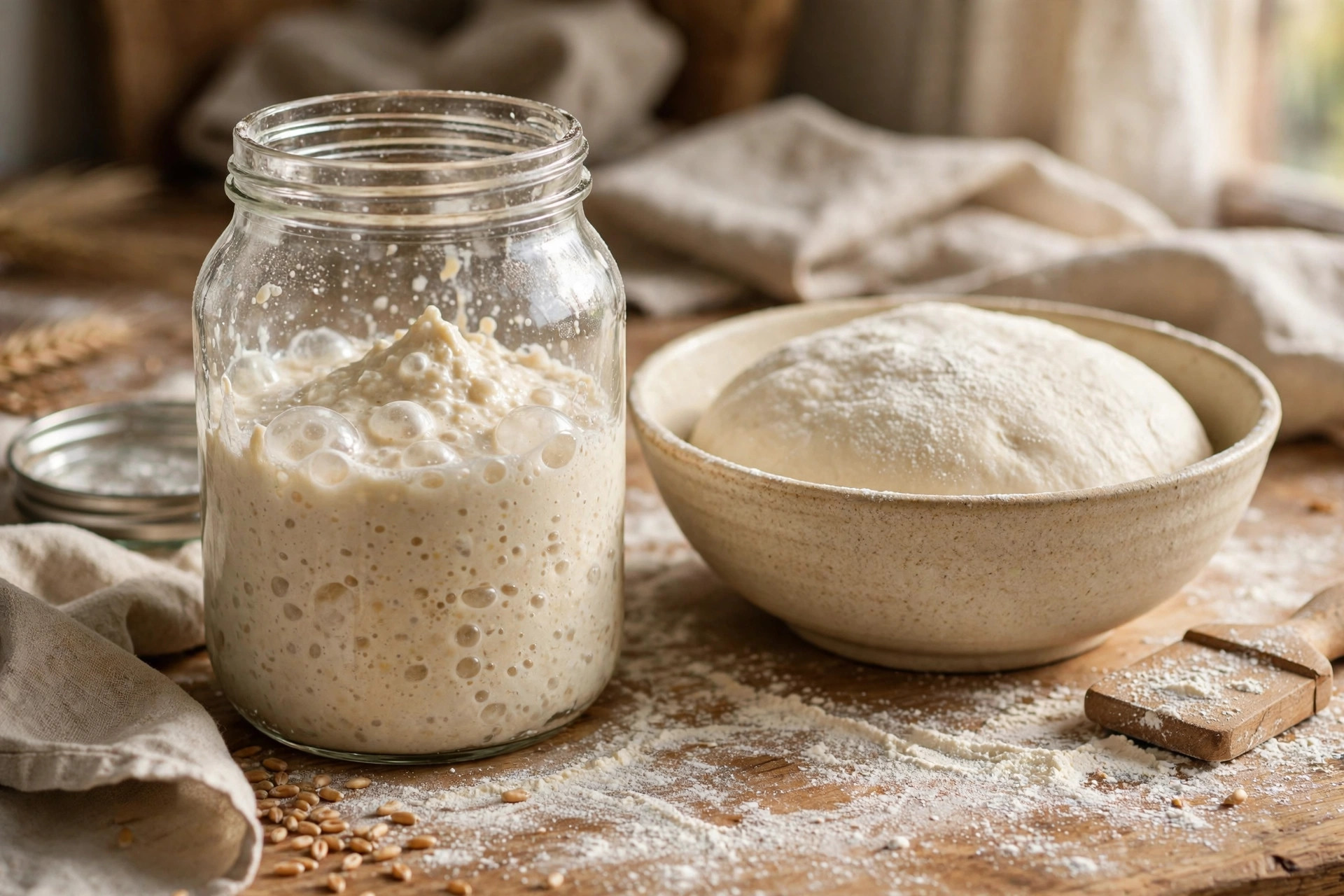
Every sourdough pizza failure has the same root cause, and it is rarely the pizza recipe. It is the starter: used too young, used past its peak, or dosed by a formula whose timing assumes a starter strength the jar on the counter does not have. Yeast doughs forgive because the yeast quantity is printed on the packet. Sourdough moves that variable into the baker’s hands, which is why this guide works backwards — starter readiness first, formula choice second, and only then the mixing, folding, and baking steps that most recipes lead with.
Ripe is not the same as active
King Arthur Baking’s starter guidance draws the line precisely. A fed starter a few hours in can be visibly active — expanding, bubbling, clearly alive — and still not be ripe, meaning not yet at the top of its growth arc and not at full strength for raising dough. In their documented timeline, a starter fed at 8 a.m. was active but unripe at 1 p.m., five hours after feeding; by 4 p.m., eight hours after feeding, it had doubled in volume and showed signs of just beginning to sag under its own weight — and that, they say, is ripe and ready to be added to dough. Their general readiness rule: a ripe starter is very bubbly and reliably doubles in size within 6 to 8 hours of feeding.
The popular float test does not survive King Arthur’s scrutiny, and their verdict is worth quoting in substance: no, it is not a good test. Both partially risen dough and growing-but-unripe starter will float in water, so a floating spoonful proves only that some gas exists. The test is not useless in reverse — starter that sinks is definitely not ready — but a pass tells the baker almost nothing. The reliable checks are the ones in the timeline above: has it doubled, is it bubbly throughout, and is it just beginning to sag at the top? A refrigerated starter needs waking first: King Arthur’s revival routine discards down to 50g of starter and feeds it 50g each of flour and water every 12 hours at room temperature until it is doubling predictably, which can take a few feedings.
Three published formulas, compared honestly
Published sourdough pizza formulas differ most in how much starter they ask for, and the percentage — starter weight as a share of flour weight — predicts the schedule better than any other number. The table below is this guide’s own arithmetic on three published recipes, all checked on October 18, 2026; percentages are computed from the listed ingredient weights and are labelled as the guide’s calculation, not the recipes’ own figures.
| Formula | Starter | Starter % of flour | Shape of the schedule |
|---|---|---|---|
| Salt Butter Smoke (pure starter) | 80g ripe starter to 600g ‘00’ flour, 355g water, 19g salt | About 13% | Starter peaks 4–6 hours after feeding; 1-hour autolyse before mixing; cold prove over 2 days for flavour |
| Sarah’s Sourdough (pure starter) | 100g active starter to 500g flour, 375g water, 10g salt, 20g olive oil | 20% | Bulk ferment about 8 hours at 70°F until doubled; balls cold-proof up to 48 hours |
| King Arthur discard crust (starter + yeast) | 227g unfed discard to 300g all-purpose flour, plus 1/2 teaspoon instant yeast | About 76%, plus added yeast | Same-day: knead about 7 minutes, rise 2–4 hours, bake at 450°F |
Read the table as three different tools, not three competing claims to correctness. The low-percentage formula leans on time — a small dose of ripe starter, a long ferment, and a two-day cold prove — and produces the deepest flavour with the least sourness risk. The 20% formula is the middle path: enough starter to finish bulk fermentation in a working day at room temperature. The discard formula is a different category altogether: the unfed starter is there for flavour, and the added commercial yeast does the lifting, which is exactly why it can run same-day and why it tolerates a starter that would fail the readiness checks above. Choosing between them is a scheduling decision before it is a flavour decision.
Pick your schedule first
The decision framework runs on one question: when is the starter at its peak relative to when mixing can start? If the starter can be fed in the morning and mixed at its 4- to 8-hour peak, a pure-starter formula fits, with the cold prove absorbing any wobble in pizza night itself — balled dough waiting in the fridge is patient in a way bulk dough on the counter is not. If pizza is tonight and the starter is wherever it happens to be, the discard-plus-yeast formula is the honest choice, because it does not pretend an unripe starter will perform. If the starter has been refrigerated for a week or more, neither formula should start today: run the 12-hour feeding cycle until it doubles reliably, then schedule the pizza. Skipping the revival is the single most common reason a “proven recipe” produces a dense, pale crust.
Sourdough pizza dough, step by step
The procedure below follows the 20% formula’s published method, with the readiness checks from the section above built in as gates. One: feed the starter and wait for ripe, not just active — doubled, bubbly throughout, just beginning to sag; allow 4 to 8 hours depending on the starter and the kitchen. Two: stir 100g of the ripe starter into 375g warm water with 20g olive oil until cloudy, add 500g flour and 10g fine sea salt, and mix until no dry flour remains. Three: cover and rest 20 to 30 minutes. Four: complete three rounds of stretch-and-folds, spaced 20 to 30 minutes apart, until the dough feels noticeably stronger each round. Five: bulk ferment at room temperature until doubled, airy, and slightly jiggly — about 8 hours at 70°F in the source recipe; colder kitchens run longer, and the doubling, not the clock, is the gate. Six: divide into two balls of about 450 to 460g, coat each thinly with olive oil, and rest seam-side down in covered containers. Seven: either proof 1 to 2 hours at room temperature, or cold-proof in the fridge for up to 48 hours, bringing cold dough back toward room temperature before shaping so it stretches without tearing. Eight: preheat the oven to 500°F with a steel or stone inside for at least 30 minutes. Nine: dust a ball generously with semolina, dimple around the outside to form the rim, stretch gently onto a floured peel, top, and launch onto the hot surface.
What success looks like: the dough ball stretches to a full round without springing back or tearing, the baked rim is puffed and blistered with an open crumb, and the flavour is tangy at the level of good bread rather than sharp or vinegar-like. A crust that bakes dense and gummy almost always traces to step one or step five — starter used before its peak, or bulk fermentation cut before the dough doubled. A crust that tastes aggressively sour usually means the starter was used after it had peaked and fallen, or the cold proof ran at the long end in a warm fridge; the fix is timing, not ingredients.
FAQ
Does the float test work at all? Only as a negative. Per King Arthur Baking, unripe starter can float, so floating proves little; sinking, however, settles the question — that starter is not ready. Use the doubling-and-sag checks instead.
Can discard be used straight from the fridge? In the discard formula, yes — that is its design: 227g of unfed starter for flavour with 1/2 teaspoon of instant yeast supplying the rise, a 2- to 4-hour rise, and a 450°F bake. What discard cannot do is leaven a pure-starter formula on schedule; that job needs a fed, ripe starter.
How long can balled dough wait in the fridge? The pure-starter formulas above bracket the window: about 2 days of cold prove in one, up to 48 hours in the other. Treat 48 hours as the working ceiling for pizza dough balls, and bring them back toward room temperature before shaping.
General cooking information only. Fermentation times shift with kitchen temperature and starter strength; judge the dough by the stated readiness checks — doubling, bubbles, and the first hint of sag — rather than by the clock alone.