Stretching pizza dough by hand: a beginner's step-by-step
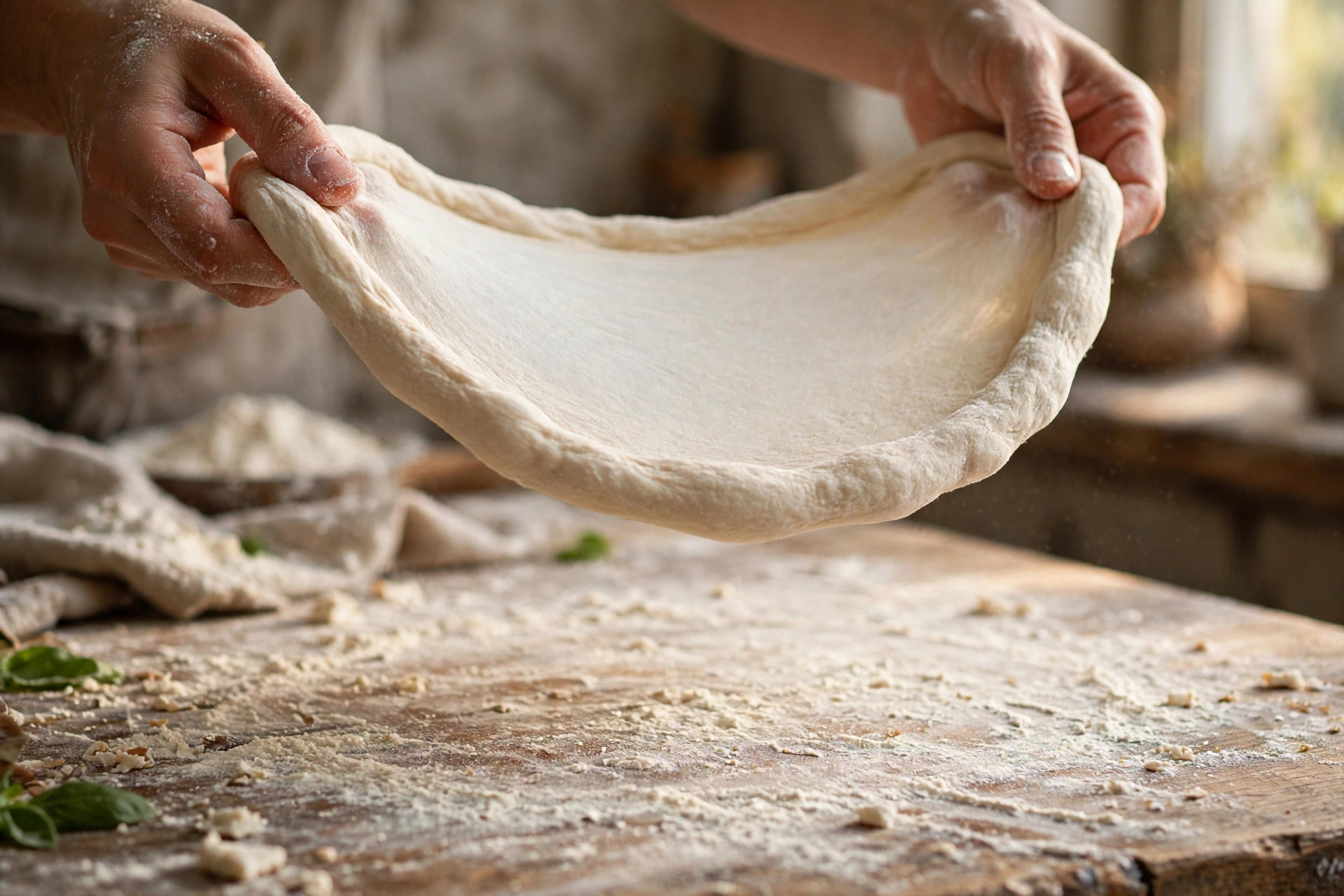
Shaping is the moment most home pizzas are won or lost. Press too hard and you squeeze the air out of the crust; fight the dough and it springs back into a blob; stretch thin spots and they tear. The good news: hand stretching is a simple technique with a readiness check, a repeatable sequence, and a fix for every common failure. Here's the whole thing.
The readiness check: is your dough ready to stretch?
Most stretching disasters are readiness disasters. Before your hands touch the dough, confirm three things:
- Room temperature. Dough straight from the fridge fights you — the gluten strands are tense and refuse to relax. Let a refrigerated dough ball sit at room temperature until it's no longer cold to the touch.
- Fully proofed. The dough should look puffy and relaxed, not tight and springy. Tense, springy dough needs more rest — the gluten strands haven't relaxed yet.
- Rested after handling. If you just balled the dough or turned it out of its container, give it 10–15 minutes to relax before you start pressing.
Under-rested or cold dough is the usual cause of spring-back. If the dough resists, the answer is almost always "wait," not "push harder."
Step-by-step: the fingertip + steering-wheel method
- Flour lightly. Dust the work surface and your hands with flour (or fine semolina) so nothing sticks — generous, but not caked on.
- Define the crust. Place the dough ball on the surface and, with your fingertips, press a ring about an inch in from the edge. This marks the cornicione — the puffy rim — and protects it from being pressed thin during stretching.
- Press from the center out. Using your fingertips, press the dough outward from the center, spiraling gradually outward in a clockwise motion until you reach the crust ring you defined. Never press the rim itself.
- Lift to the steering wheel. Pick the dough up by the crust, as if holding the top of a steering wheel. Rotate it, passing it from one hand to the next as though turning the wheel. Gravity does the stretching — don't pull, just let it fall and turn.
- Refine on the backs of your hands. As it grows, drape it over the backs of your hands and keep rotating. This softer surface reduces the risk of tearing, and your knuckles can gently work the thicker areas near the rim while the thin center takes a break.
- Lay it down and adjust. Stop when the center is about an eighth of an inch thick and the round is roughly 12 inches across. Lay it on your peel or pan and nudge the shape round with your fingertips.
The three classic failures and the fix for each
- Spring-back. The dough keeps shrinking toward its original size. Cause: tense gluten — it's too cold or hasn't rested. Fix: walk away, let it rest, and try again. Fighting it tears it.
- Tears. A hole opens in the center. Cause: overworked thin spots, or fingernails. Fix: lay the dough down immediately and pinch the hole shut, then let it rest before continuing. Keep nails short and stay on the backs of your hands once it's thin.
- Thin spots. You can see through patches. Cause: stretching the same area repeatedly. Fix: stretch the thicker parts near the rim, not the thin center, and rotate a quarter-turn between stretches so every section gets equal attention.
Rolling pin vs. hands: when each is fine
Use this quick chooser:
- Hands: pizza with a puffy, airy rim (Neapolitan, New York style). Hand stretching preserves the air bubbles in the crust. A rolling pin knocks those bubbles out and can make the dough shrink, tear, or bake up dense.
- Rolling pin: thin, cracker-style crusts and pan pizzas where an even, uniform base matters more than an airy rim. Here the pin is a tool, not a shortcut.
What success looks like
A round roughly 12 inches across, about an eighth of an inch thick in the center, with a defined puffy rim you never pressed. It drapes over your hands without tearing and lies flat on the peel without springing back. If yours looks more like a map of a small country than a circle — congratulations, that's normal for the first dozen. It will still taste great, and roundness comes with practice.