How much sauce and cheese for a 12-inch pizza: a home portion guide
The most common homemade-pizza mistake isn't in the dough — it's on top of it. Too much sauce makes a soggy center; too much cheese makes a greasy, slow-baking blanket; too many toppings turn the whole thing into a casserole that never quite cooks through. The fix is portioning: knowing how much goes on before you start scooping. (A note on format: this is a reference guide, not a procedure — there's no numbered process here because portioning is a lookup, not a sequence. The one step is: measure, then top.)
The home portion table
Professional pizzerias weigh everything; at home, cups and spoons are enough. Use these starting points for a standard round pizza, then adjust to taste:
| Pizza size | Sauce | Shredded mozzarella |
|---|---|---|
| 10-inch | 3 oz / ~6 Tbsp | scale the 12-inch figure down |
| 12-inch | 3–4 oz / ~½ cup | 5–6 oz / 1–1½ cups |
| 14-inch | 6 oz / ~¾ cup | scale the 12-inch figure up |
The 12-inch numbers line up across sources: home pizza makers land on about 3 ounces of sauce and 5–5.5 ounces of cheese, and pro sauce charts call for 4 ounces of sauce on a 12-inch pie. The 10- and 14-inch cheese figures aren't standardized for home kitchens, so scale the 12-inch baseline (5–6 oz) by pizza size and adjust to taste. The cup and ounce columns are two ways to measure the same target — use whichever you have handy.
Sauce: thin and spreadable beats thick and heavy
Amount is only half the sauce equation — consistency is the other half. A thin, watery sauce seeps into the dough and creates a soggy crust no matter how little you use. If your sauce is watery, simmer it down or drain it before it goes on the pizza.
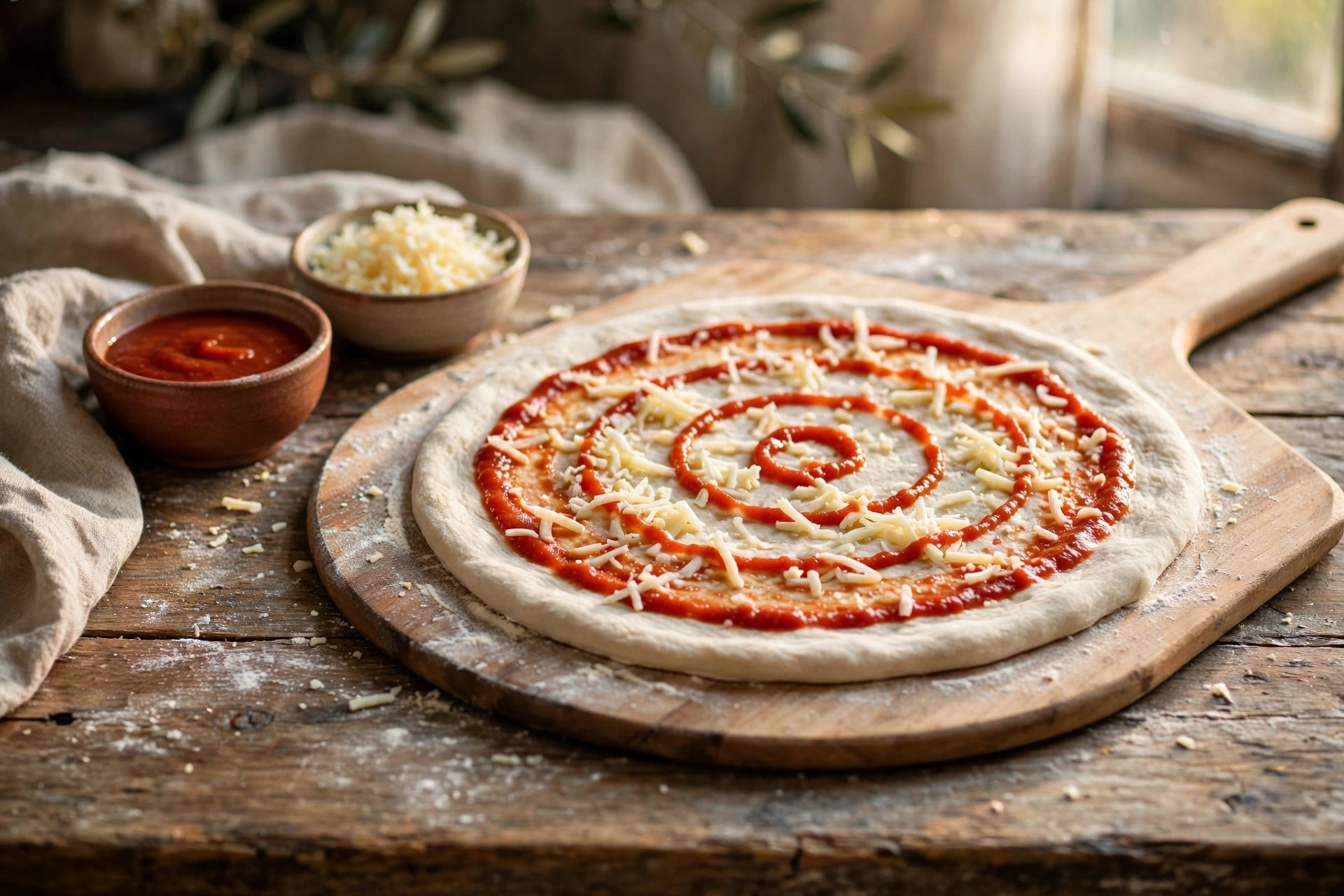
To apply: put one scoop in the center and spiral it outward with the back of a ladle, two to three spirals for a medium pizza, leaving a clear border for the crust. Keep the layer thin enough that you can still see the dough through it in places — if the sauce completely hides the dough, you've used too much. Spread it evenly with no bare spots and no heavy ridges.
Cheese: coverage, not a blanket
For a 12-inch pizza, 1 to 1½ cups of shredded cheese is the target zone — enough for full coverage, not a cheesy avalanche. Consider putting the cheese down before the other toppings: it acts as a shield, locking the sauce in and protecting the crust from the moisture the toppings above will release. A sprinkle of parmesan on top is seasoning, not structure — it doesn't count toward your cheese total.
The less-is-more rule: topping count and portion math
Every topping adds weight and moisture, and your home oven has a fixed amount of heat to drive that moisture off. This is the decision framework:
- Cap the count. Stick to four toppings at most. More than that and the moisture gets trapped in the dough, the bake time stretches, and the crust steams instead of crisps.
- Shrink portions as count rises. A two-topping pizza can carry full portions of each. A four-topping pizza needs each topping lighter — think a scattering, not a layer — or the total load exceeds what the crust can support.
- Wet toppings go light. Fresh vegetables, pineapple, and fresh mozzarella release water as they cook. Use them sparingly.
Portion with the oven you have, not the oven you wish you had.
A visual check before the oven
Stand back and look at the topped pizza. You should see: sauce visible only as a thin layer, cheese in an even scatter with dough peeking through in spots, toppings distributed without piles, and a clean bare border around the edge. If it looks abundant — a little sparse, even — it's right. The oven concentrates flavors; the pizza that looks "generous" raw comes out heavy.